



Introduction
Water Transversality frames water not as a stand-alone utility but as a cross-cutting enabler of equitable social development, livelihoods, and human dignity an integrated approach that directly supports the coordinated, inclusive policy agenda of CSocD64 and the 2030 Agenda. By anchoring water at the heart of development planning, this approach helps reduce multidimensional poverty: safe drinking water, sanitation and hygiene reduce disease burdens and time poverty (especially for women and girls), while reliable water supply for productive uses strengthens food security, supports nutrition outcomes, and enhances household resilience. Integrated water governance advances health and food security by enabling cross-sectoral planning that connects water, agriculture, and nutrition with public health and economic systems. Recent global data show that 2.2 billion people still lack safely managed drinking water and 3.4 billion lack safely managed sanitation, underscoring persistent inequities that water-centred strategies can address through inclusive policy design.
This integrated lens also strengthens climate resilience in vulnerable communities by supporting climate-smart agriculture, sustainable fisheries, and water-efficient small enterprises that generate inclusive employment and incomes across rural and peri-urban landscapes. Investing in robust water governance frameworks such as Integrated Water Resources Management and multi-stakeholder partnerships promotes equitable access, reduces risk, and fosters local innovation. It also showcases policy innovation that highlight linking water management with social protection and social inclusion programmes, enabling social safety nets that integrate access to water services with livelihoods support, and coordinated financing mechanisms that bridge public, private, and community action. Together, these pathways demonstrate how water transversality can accelerate poverty reduction and systemic resilience in alignment with SDG 6 and broader UN development priorities.
Objective
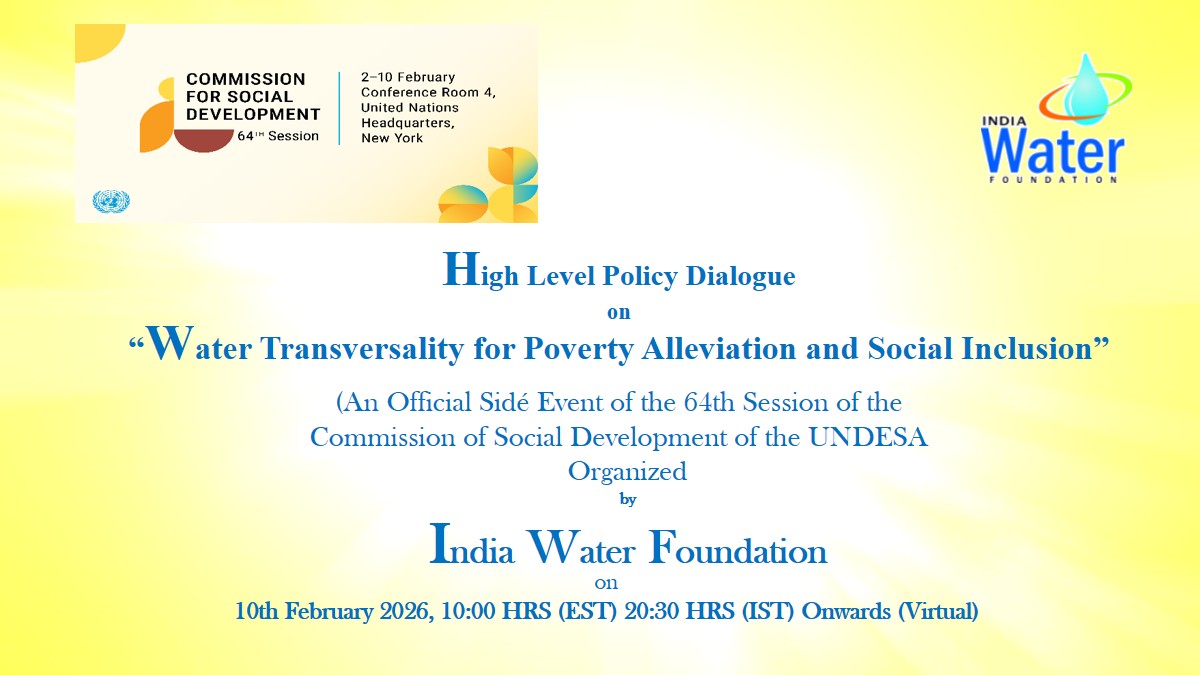
The session aims to demonstrate how Water Transversality can be operationalized as an integrated policy and practice framework to accelerate poverty eradication, social development, and social inclusion. It seeks to reposition water from a sector-specific concern to a strategic enabler that connects livelihoods, health, food security, climate resilience, and dignity, particularly for vulnerable and marginalized communities. The session seeks to contribute actionable insights to CSocD64 by advancing coordinated, equitable, and inclusive policy approaches, while reinforcing water’s central role in achieving the 2030 Agenda and ensuring that no one is left behind.
Joining Link: https://us06web.zoom.us/j/89285817836?pwd=lgFCSxPOqgwd88X2DUZF7o62aGmfYs.1#success
Meeting ID: 892 8581 7836
Passcode: 716560
CHAIR ADDRESS |
|
Dr. Raj Bhushan Chaudhary  |
|
 Dr. Raj Bhushan Choudhary is an Indian doctor-turned-politician and the Minister of State for Jal Shakti in the Narendra Modi government. He holds MBBS and MD degrees and began his political career in 2019 with the Vikassheel Insaan Party before joining the BJP in 2022. Dr. Choudhary is known for his dynamic leadership and commitment to public service. In 2024, he was elected as a Member of Parliament from Muzaffarpur with a record margin of over 234,000 votes. Associated with organizations like RSS and Nishad Vikas Sangh, he has also served as the Bihar Unit President of the National Association of Fishermen.
|
|
Eminent Speaker |
| Dr. Arvind Kumar |
Sh. Amit Kumar Ghosh |
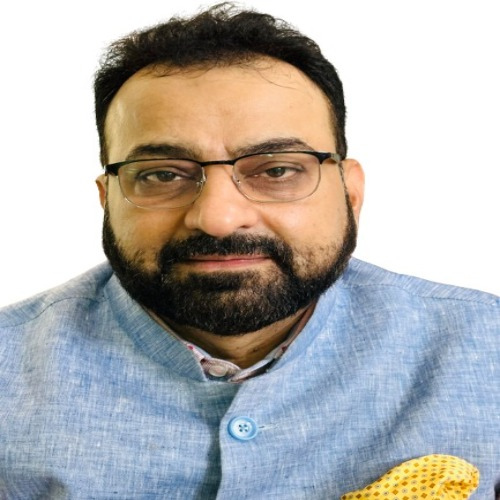 Dr. Arvind Kumar is a strategist and key-influencer in development sector with more than 31+ years of experience as an author, columnist, Water and Human Rights Pro-activist, and specializes in concepts like ecosystem-based adaptation, water-energy-food nexus, with specific emphasis on Transversal approach of inter-linkages between water, environment and SDGs. He has published over 500 plus research articles and several books. He is a proud recipient of Achievers Award for his contribution to the Environment from International Human Rights Organization in collaboration with United Nations Information Centre, India. Dr. Arvind Kumar is a strategist and key-influencer in development sector with more than 31+ years of experience as an author, columnist, Water and Human Rights Pro-activist, and specializes in concepts like ecosystem-based adaptation, water-energy-food nexus, with specific emphasis on Transversal approach of inter-linkages between water, environment and SDGs. He has published over 500 plus research articles and several books. He is a proud recipient of Achievers Award for his contribution to the Environment from International Human Rights Organization in collaboration with United Nations Information Centre, India. |
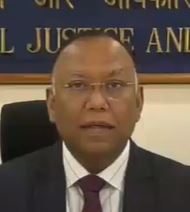 Shri Amit Kumar Ghosh is the Additional Chief Secretary in the Medical, Health & Family Welfare and Medical Education Department, Government of Uttar Pradesh. An I.A.S. officer of the Uttar Pradesh cadre, he holds a B.E. (Electronics) from Andhra University, Visakhapatnam; an M.Sc. in Public Management and Governance from the London School of Economics; and an M.A. in Defence Studies from Meerut University. Shri Amit Kumar Ghosh is the Additional Chief Secretary in the Medical, Health & Family Welfare and Medical Education Department, Government of Uttar Pradesh. An I.A.S. officer of the Uttar Pradesh cadre, he holds a B.E. (Electronics) from Andhra University, Visakhapatnam; an M.Sc. in Public Management and Governance from the London School of Economics; and an M.A. in Defence Studies from Meerut University. |
| Dr. Satya S. Tripathi | Er. Ashwin B. Pandya |
|
|
|
| Dr. Alok Sikka | Mr. Yugal Kishore Joshi |
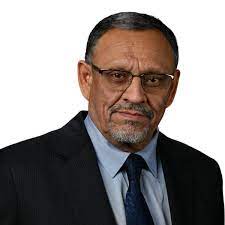 Dr. Alok Sikka is the Country Representative for India and Bangladesh at the International Water Management Institute. Previously, he served as Deputy Director General (Natural Resource Management) at the Indian Council of Agricultural Research (ICAR) and as Technical Expert (Watershed Development) with the National Rainfed Area Authority, Planning Commission, Government of India. Dr. Sikka has also been Director of the ICAR Research Complex for the Eastern Region, Patna, and Basin Coordinator for the Indo-Gangetic Basin under the CGIAR Challenge Program on Water and Food. Dr. Alok Sikka is the Country Representative for India and Bangladesh at the International Water Management Institute. Previously, he served as Deputy Director General (Natural Resource Management) at the Indian Council of Agricultural Research (ICAR) and as Technical Expert (Watershed Development) with the National Rainfed Area Authority, Planning Commission, Government of India. Dr. Sikka has also been Director of the ICAR Research Complex for the Eastern Region, Patna, and Basin Coordinator for the Indo-Gangetic Basin under the CGIAR Challenge Program on Water and Food. |
|
| Dr. Ritesh Kumar | Ms. Dhalia Sabri |
|
Dr. Ritesh Kumar is Director of Wetlands International South Asia and a specialist in integrated wetland management with over 25 years of experience. He has led major projects on wetland assessment, ecosystem services, climate adaptation, and water management across South Asia. He works closely with India’s Ministry of Environment on wetland policy and planning. Dr. Kumar serves as a coordinating lead author for UNEP’s Global Peatlands Initiative and IPBES assessments, and has published extensively on wetlands conservation. He is also on the editorial boards of Marine and Freshwater Research, Wetland Ecology and Management, and PLOS Water. |
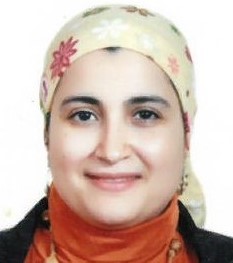 Ms. Dahlia Sabri is a member of the board of IWRA Executive Board and Water Security Task Force. She is a water resources specialist with over 19 years of experience across private sector, UN, EU-financed, and international projects. Trained as a water engineer, she has contributed to interdisciplinary assignments in Egypt, Sweden, Germany, and Kuwait, including consultancy work with the UNFCCC in Germany. Her expertise spans hydrological and environmental investigations, water and wastewater networks, irrigation, urban drainage, green infrastructure, and climate adaptation. Ms. Dahlia Sabri is a member of the board of IWRA Executive Board and Water Security Task Force. She is a water resources specialist with over 19 years of experience across private sector, UN, EU-financed, and international projects. Trained as a water engineer, she has contributed to interdisciplinary assignments in Egypt, Sweden, Germany, and Kuwait, including consultancy work with the UNFCCC in Germany. Her expertise spans hydrological and environmental investigations, water and wastewater networks, irrigation, urban drainage, green infrastructure, and climate adaptation. |
| Ms. Stefania Corrado | Ms. Shweta Tyagi |
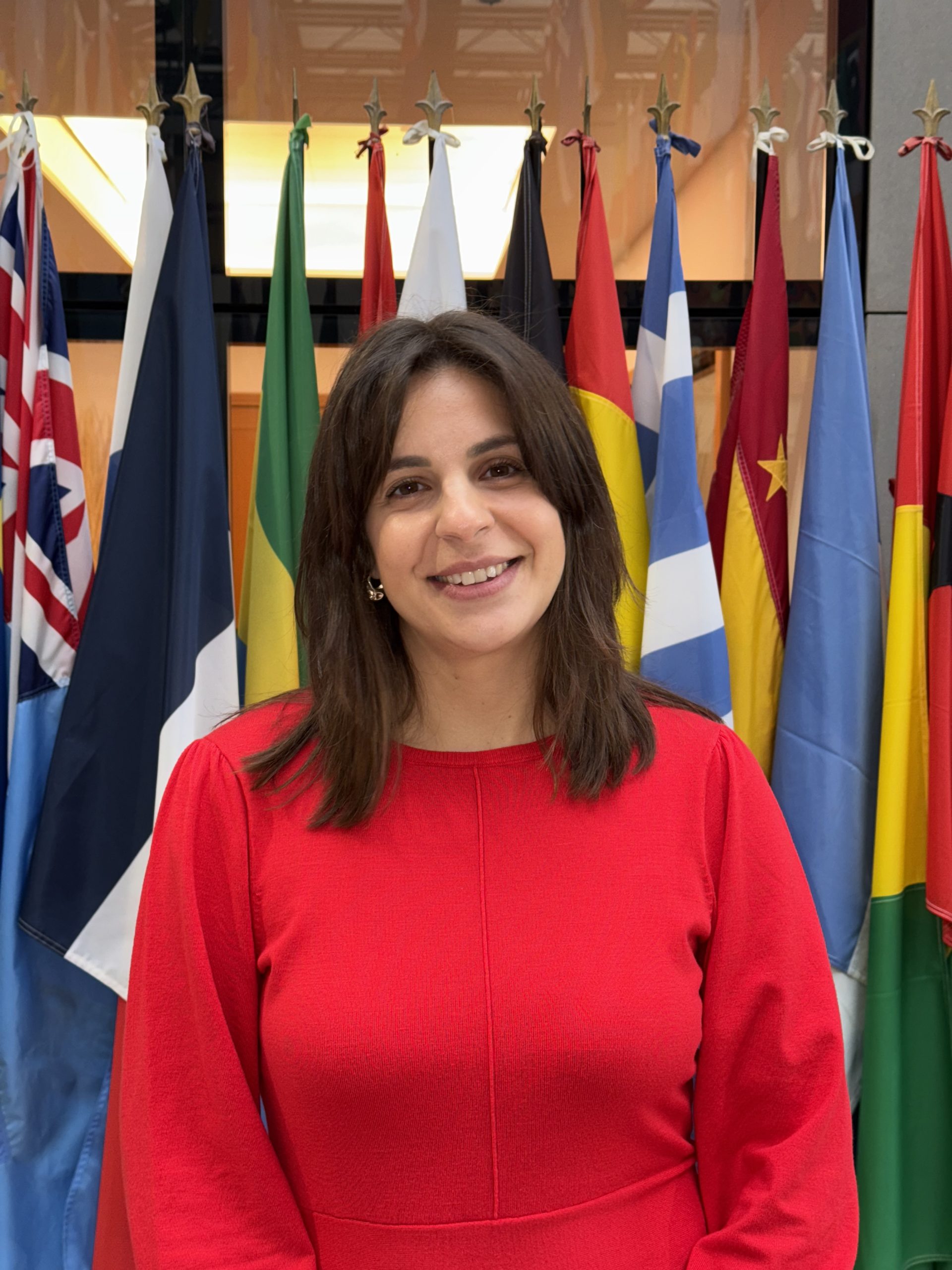 Ms. Stefania Corrado has been working at FAO headquarters in Rome since 2023 as a Communications and Advocacy Specialist for the Mountain Partnership Secretariat. With over eight years of international experience in communication and outreach, she supports communication activities and the organization of high-level events that strengthen visibility and political support for mountain communities and environments. Stefania holds a bachelor’s degree in International Relations from the American University in Washington, D.C., and is currently pursuing a master’s degree in Communication for Development at Malmö University in Sweden. Ms. Stefania Corrado has been working at FAO headquarters in Rome since 2023 as a Communications and Advocacy Specialist for the Mountain Partnership Secretariat. With over eight years of international experience in communication and outreach, she supports communication activities and the organization of high-level events that strengthen visibility and political support for mountain communities and environments. Stefania holds a bachelor’s degree in International Relations from the American University in Washington, D.C., and is currently pursuing a master’s degree in Communication for Development at Malmö University in Sweden. |
 Ms. Shweta Tyagi is Chief Functionary, India Water Foundation. She is results-focused development sector professional with a 23 years of demonstrated history and a proven ability to manage project teams to deliver multiple projects and programmes across diverse sectors of sustainable Development, Water and Sanitation, Social Development, Livelihood Generation, climate change etc. Excellent knowledge of project management and strategic planning of partnership creation and coordination, as well as advising decision-makers and strengthening capacities. Experience of Natural Resource management among rural communities for implementing. Ms. Shweta Tyagi is Chief Functionary, India Water Foundation. She is results-focused development sector professional with a 23 years of demonstrated history and a proven ability to manage project teams to deliver multiple projects and programmes across diverse sectors of sustainable Development, Water and Sanitation, Social Development, Livelihood Generation, climate change etc. Excellent knowledge of project management and strategic planning of partnership creation and coordination, as well as advising decision-makers and strengthening capacities. Experience of Natural Resource management among rural communities for implementing. |

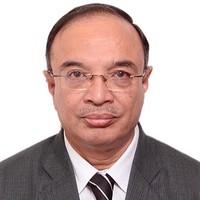 Er. Ashwin B. Pandya currently serves as Chair – South Asia, Global Water Partnership. He is the former Chairman of the Central Water Commission (CWC) and former Secretary General of the International Commission on Irrigation and Drainage (ICID). An alumnus of IIT Delhi, he has over 40 years of professional experience in water resources and irrigation planning, design, implementation, and financing. He specialises in the design of dams and underground structures and is actively engaged in dam safety assessment, assurance, and rehabilitation technologies. He has held senior Government of India positions and has authored over 20 technical publications.
 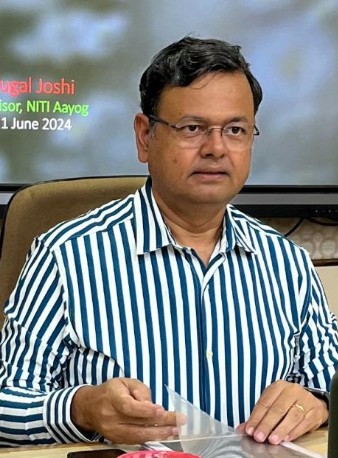 Shri Yugal Kishore Joshi is a Programme Director at NITI Aayog, the Government of India’s premier public policy think tank. He oversees key sectors including Drinking Water and Sanitation, Water and Land Resources, IT and Telecom, Tourism and Culture, and also leads communications and North-East region engagement. He plays a significant role in policy design, inter-ministerial coordination, and implementation support for national development initiatives. Previously, he served as Director, Swachh Bharat Mission and Director, Jal Jeevan Mission under the Ministry of Jal Shakti. He is a recipient of the Prime Minister’s Award for Excellence in Public Administration and the Indian Police Medal for Meritorious Service.
For more information please contact-
Ms. Shweta Tyagi
Chief Functionary
India Water Foundation
Email: shweta.tyagi@indiawaterfoundation.org
Mobile: +91 9899819074